Welcome to LED-Resource!

LED-Resource is a brand new site in the SmartDeviceResource network, and we hope that LED-Resource will be your one-stop source for information about LEDs in our everyday lives. Some of you might be wondering that they are or what’s so special about LEDs, and we hope this site will raise awareness towards the benefits that LEDs can bring to everyday lighting needs. Or, maybe even cultivate a passion for bringing LEDs to your home!

If you look around, chances are that there are at least a couple LEDs around you. Wait, we take that back. Take a closer look at the power button on your LCD monitor, or the status lights on your laptop. Those are all LEDs! LEDs have been in computers for a long time. They offer bright, long-lasting light in a small package, which is also why the backlight and status light in your cell phone is also an LED. In this article, we will give a brief guide to the benefits that LEDs offer, compared to traditional lighting sources.

Longevity

One of the best advantages that an LED offers is a very long lifetime. We’ve all had to deal with burnt out light bulbs, and sometimes, troubleshooting these bulb failures can be quite troublesome, such as in Christmas lights. LEDs typically offer rated hours in the thousands of hours, sometimes as high as 100,000 hours. That’s equivalent to having the LED turned on continuously for more than 10 years!

For this reason, traffic lights are turning to LEDs to provide illumination for years to come.

Efficiency

Light bulbs tend to be a great source of heat, which is why it’s never a good idea to touch a lit bulb. Over 90% of an incandescent bulb’s energy is used to produce heat, making them rather inefficient. Most common LEDs operate at temperatures we consider to be cool to the touch. However, new high-powered LEDs such as the Philips Lumileds Luxeon or Cree X-Lamp do require heatsinking to dissipate heat for safe operation, but the amount of heat produced is much less than a comparable incandescent bulb would produce.

For this reason, constant-on devices like night lights feature LEDs and only cost pennies per year to operate.

Reliability

LEDs, or Light Emitting Diodes, are semiconductors, making them considered to be “solid state lighting.” This means that the light source is much more resistant to temperature extremes, shock, and vibration, factors that can lead to incandescent failure.

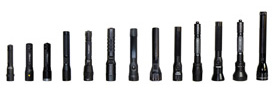
For this reason, LED flashlights are increasing in popularity.

Instant-On

Both incandescent and the newer compact fluorescent lights, or CFLs, have a drawback – slow starting. This is most noticeable in CFLs, where they take a while to reach full brightness. Incandescents also gradually increase in brightness, but with LEDs, output will be 100% from the moment current is applied across the diode. Some cars use LEDs for the high mount stop lamp (sometimes called the third brake light) and incandescents for the regular stop lamps, and in this situation, the instant-on of the LEDs are much more noticeable. The fraction of a second difference could be the difference in whether or not the car behind you stops in time.

For this reason, LED taillamps are often marketed as part of a vehicle’s safety features.

Comments are closed.